Welcome to the Shibli National Academic Journal
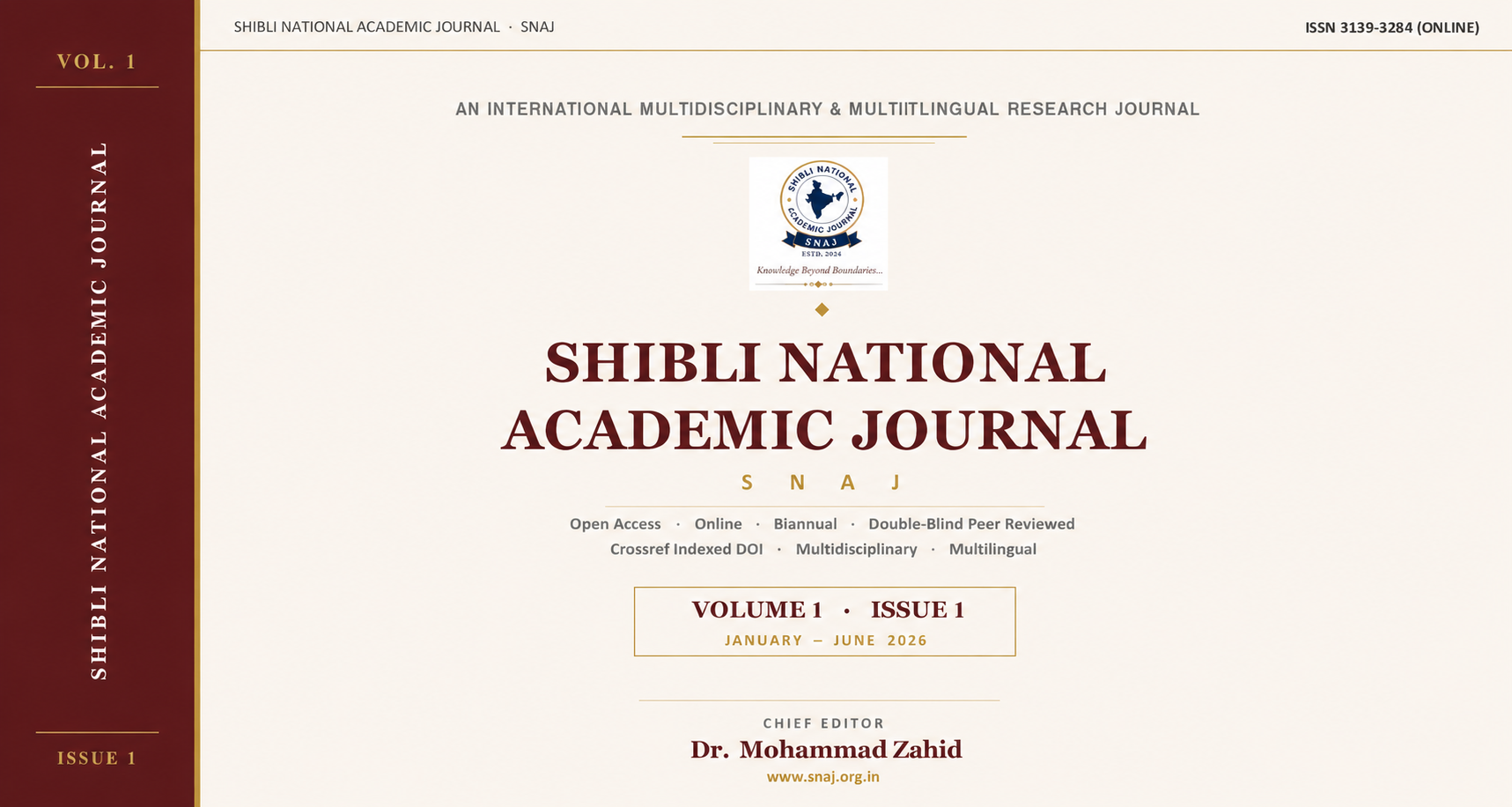
An International Multidisciplinary & Multilingual Peer-Reviewed Research Journal
SNAJ is committed to advancing knowledge by publishing original research papers, reviews, and case studies from diverse fields such as humanities, social sciences, science, technology, and education. Our vision is to provide a global academic platform where researchers and scholars can share innovative ideas and contribute to the progress of society through quality research.
About the Journal
The Shibli National Academic Journal (SNAJ) is An International Multidisciplinary & Multilingual Peer-Reviewed Research Journal. It provides a platform for academicians, researchers, and professionals to publish high-quality original research, review articles, and case studies across a wide spectrum of disciplines.
The journal emphasizes:
- Interdisciplinary and innovative research
- Multiples academic exchange (English, Hindi, Urdu, Sanskrit etc)
- Global visibility with local relevance
- Academic integrity and quality through double-blind peer review
Aims and Scope
The journal aims to:
- Encourage interdisciplinary research across multiple domains.
- Publish original and innovative research that contributes to knowledge and practice.
- Promote academic excellence and scholarly exchange.
- Support early-career researchers and academicians in publishing their work.
Scope of the Journal
Includes (but is not limited to):
- Social Sciences (Sociology, Political Science, Economics, History etc.)
- Humanities (Literature, Philosophy, Linguistics, Culture etc.)
- Science and Technology (Computer Science, AI, Environment, Physics, Biology etc.)
- Education & Teacher Training etc.
- Commerce, Management, and Law etc.
| Publication Frequency | Two issues per year |
| Language of Publication | English, Hindi, Urdu, Sanskrit & Marathi Etc. |
| Starting year | 2025 |
| Format | Online |
| Subject Area | Education, Sociology, History, Law, Political Science, Botany, Physics, Computer Science, Geography, Economics, Hindi, Urdu, English (Multidisciplinary). |
| Publishing Body | Rahman Shikshan Sewa Sasthan Village: chichoro, post: chihi, city: zamgarh, pin: 276121 (uttara pradesh) |
| cheifeditor@snaj.org.in | |
| Website | www.snaj.org.in |
| Editor in Chief | Dr. Mohammad. Zahid, Contact: +91 9260947878, Email: cheifeditor@snaj.org.in, Snaj1883shibli@gmail.com, z.azmi77@gmail.com |
Guidelines for Authors
- Length: 3000–6000 words
- Format: MS Word, Times New Roman, 12 pt, 1.5 spacing
- Abstract: 150–250 words with 4–6 keywords
- Referencing Style: APA 7th Edition (preferred)
- Submission: Manuscripts should be original, unpublished, and not under review elsewhere.
- Figures & Tables: Properly numbered, titled, and referenced.
- Plagiarism Policy: Similarity must not exceed 10%.
Contact Information
Publishing Body:
Address: Rahman Shikshan Sewa Sansthan Village Chichori, Post Chihi Azamgarh, Uttar Pradesh – 276125 uttarprdesh India
Email: cheifeditor@snaj.org.in
z.azmi77@gmail.com
Snaj1883shibli@gmail.com
Phone: +91 9260947878
WhatsApp: +91 8736900777
Owner / Responsible Person:
Dr. Mohammad Zahid
Assistant Professor
Address: Darul Aman colony Balrampur post pathkauli Thana Kotwali sadar district Azamgarh pincode 276001 Uttarpardesh
Email: cheifeditor@snaj.org.in
z.azmi77@gmail.com
Snaj1883shibli@gmail.com
Phone: +91 9260947878
WhatsApp: +91 8736900777
Policies
A.) Plagiarism Policy
1. Permissible Similarity Threshold
- The maximum acceptable similarity index is 10%. Any submission exceeding this threshold can be returned for revision or outrightly rejected.
- Journals commonly employ plagiarism-detection software like Turnitin, iThenticate, or Urkund to enforce this standard.
2. Plagiarism Detection & Institutional Procedures
- Institutions must establish an Institutional Academic Integrity Panel (IAIP). At MES Kalladi College, for instance:
- The Principal acts as the Chairperson of the IAIP.
- All PG dissertations and PhD theses must be screened using approved software.
- A screening certificate must accompany the final thesis submission.
3. Official UGC Regulations
- The “Promotion of Academic Integrity and Prevention of Plagiarism” Regulations, 2018 set the foundational framework for plagiarism policy in higher education institutions.
- Procedural mandates include:
- Defining plagiarism categories (based on similarity percentage).
- Establishing IAIP as a formal mechanism for handling allegations.
- Recommending consistent certification and reporting workflows.
4. Institutional Practices & Software Updates
- Recent news highlights concerns around the UGC’s new plagiarism detection software, Drillbit:
- Bharathidasan University (BDU) finds Drillbit effective at identifying AI-generated text but less reliable compared to tools like Turnitin for detecting complex plagiarism.
- BDU allows up to 10% similarity in PhD theses and screens approximately 60 submissions per month, though monitoring limitations and additional usage costs have emerged.
B.) UGC Plagiarism Policy
Double-blind peer review ensures fairness and quality.